

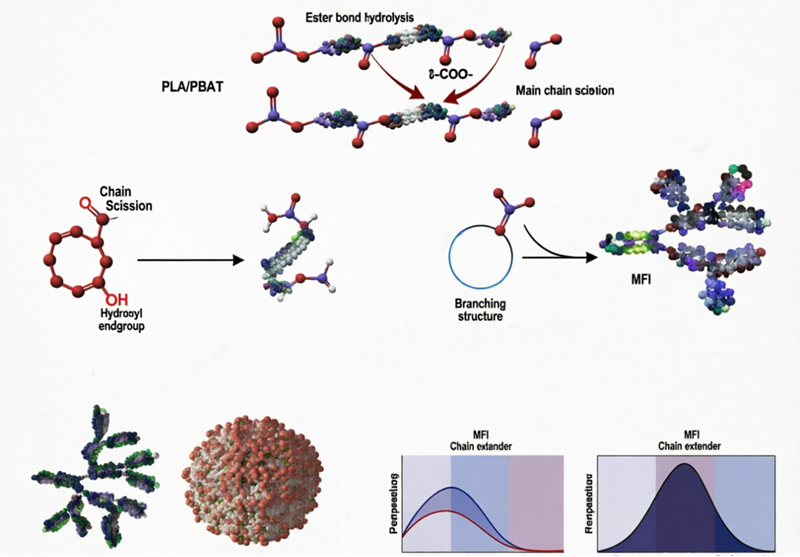
An epoxy chain extender for biodegradable plastics is not a “nice-to-have” additive. It is a molecular-weight recovery tool. PLA and PBAT lose intrinsic viscosity (IV) within a single extrusion pass, and rPET from bottle flake arrives at the compounder already below the IV floor required for film or filament. The result is measurable and repetitive: bubble instability on the blown-film line, cell collapse in foaming, sag in injection molding, and edge trim that will not track. Epoxy-functional oligomers rebuild chain length by coupling the carboxyl and hydroxyl ends left behind by thermal and hydrolytic scission. The engineering decision is not whether to use one, but which architecture — high-epoxy-equivalent branched resin (DB-10) or granular high-compatibility grade (DB-G) — matches a given degradation profile and feed system.
Degradation Mechanisms in Aliphatic Polyesters and Recycled PET
Thermal and Hydrolytic Scission: Drop in Molecular Weight and Inherent Viscosity
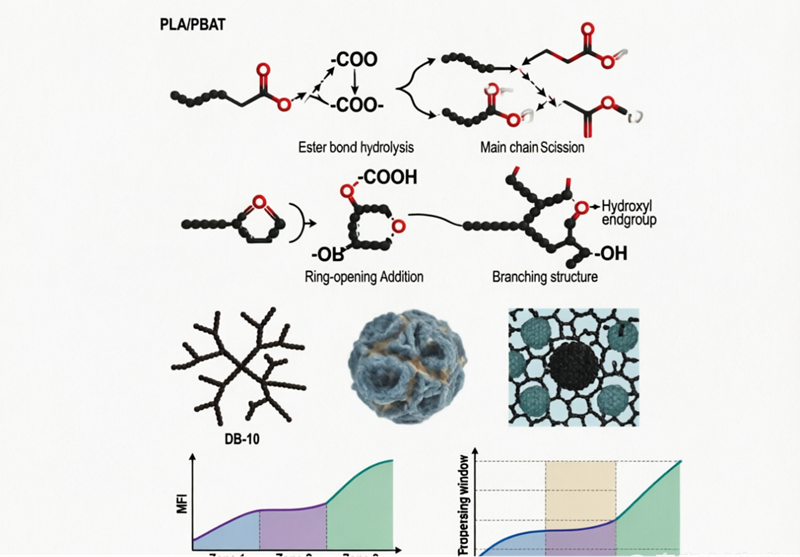
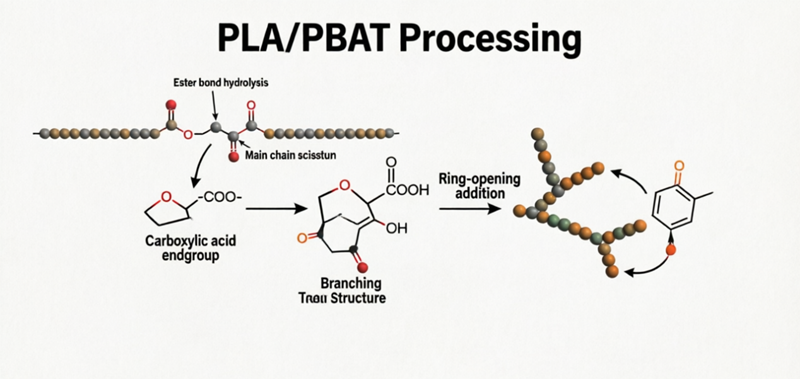
The scission chemistry is not identical across the three substrates, but the rheological consequence converges. For PLA, random main-chain scission dominates within the 180–220 °C processing window; even a 3-minute extrusion residence produces a measurable IV decline. PBAT undergoes the same hydrolytic and random-scission route, with ester bond cleavage generating new carboxyl end groups that further autocatalyze hydrolysis. rPET enters the extruder with a lower starting molecular weight than virgin PET and continues to degrade during melting; mechanical recycling through an extruder is “prone to impart the recycled PET performance due to a reduction in molecular weight and intrinsic viscosity”.
The practical fingerprint is a rise in MFI and a drop in die swell. A resin that ran at 3–5 g/10 min (190 °C/2.16 kg, ASTM D1238) may drift above 10 g/10 min after two passes, at which point the melt no longer supports its own weight in a bubble or a parison.
Processing Challenges: Bubble Instability, Foam Collapse, and Brittleness
Low melt strength does not present as a single failure mode. In blown film, the bubble neck-in becomes erratic and the frost line fluctuates; in foaming, the expanding cells rupture before stabilization; in injection molding, the melt sags in the runner and produces short shots or dimensional drift. On the material side, the same chain scission that lowers viscosity also raises brittleness because the entanglement density required for toughness is lost. The formulation target is therefore not “maximum molecular weight” but a controlled, branched architecture that raises low-shear viscosity without introducing an intractable gel fraction.
Chemical Structure & Action Mechanism: Epoxy Oligomer Chain Extension
Ring-Opening Addition with Carboxyl and Hydroxyl End Groups
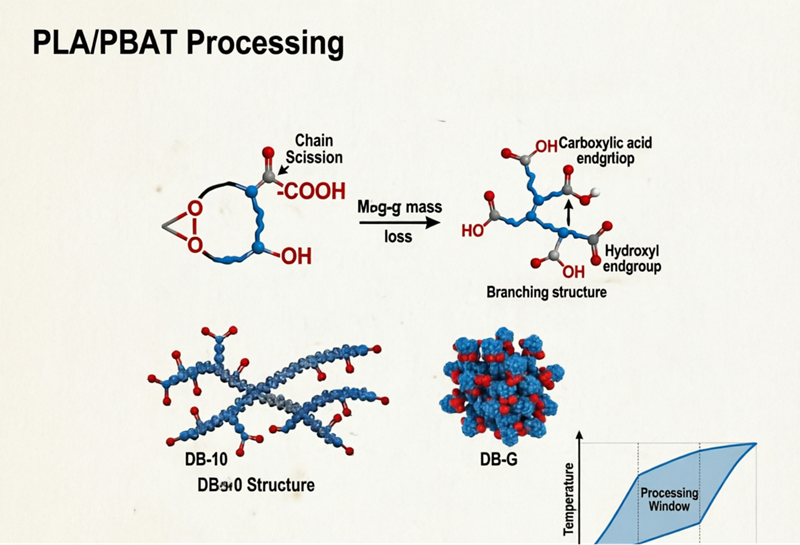
The reactive site is the oxirane (epoxy) ring. In a polyester melt, the ring opens and adds to a terminal carboxyl group, forming an ester linkage and a new hydroxyl; it also reacts with terminal hydroxyls under appropriate catalysis. In PLA/PBAT systems, this reaction produces extended macromolecules and, at the interface, PLA-g-PBAT amphiphilic species that improve phase compatibility. The reaction is stoichiometric with respect to epoxy groups but kinetically governed by temperature, residence time, and the local concentration of accessible end groups. This is why the same chain extender can behave as a coupling agent at 0.3% and as a gel precursor at 1.5% in the same resin.
Epoxy Chain Extender DB-10: High EEW and Branched Architecture
DB-10 is a white powder or granular grade with an epoxy equivalent weight (EEW) of 380–410 g/mol and purity ≥99.5%. That EEW sits at the upper end of the practical range for polyester chain extension: there are fewer epoxy groups per gram than a low-EEW grade, but the oligomer backbone is designed to generate long-chain branching rather than simple linear extension. In rheological terms, the branched product raises the low-frequency storage modulus and the extensional viscosity far more than a linear chain extension of the same molecular weight would. This is the property that stabilizes a blown-film bubble and prevents cell wall drainage in foaming. DB-10 is typically dosed at 0.3–1.0% by weight in PET, PBAT, PLA, and PBS, compounded on single- or twin-screw extruders.
Processing Caution: Because DB-10 builds branched architecture efficiently, overdosing compresses the reaction window toward microgel formation. The visible symptoms are fish eyes in film, die lip build-up, and a GPC trace that develops a high-molecular-weight shoulder beyond the calibration range.
Epoxy Chain Extender DB-G: Granular Dispersion Advantage
DB-G is supplied as a white powder or granular material with an EEW of 300–330 g/mol and purity ≥99.5%. The lower EEW means a higher epoxy group density per unit mass; combined with the granular form, this grade is designed for direct metering into the extruder feed throat without a pre-compounding masterbatch step. The granular geometry reduces dusting and feed-surge variation on loss-in-weight feeders, which matters when the target dosage is 0.2–1.0% and the acceptable deviation is narrow.
DB-G is the more forgiving grade for rPET and highly filled biodegradable compounds where dispersion quality governs the local reaction stoichiometry. A poorly dispersed high-EEW powder creates epoxy-rich domains that gel locally while the bulk melt remains under-extended.
Application-Specific Recipe Formulations & Rheological Optimization
PLA/PBAT Blown Film Extrusion: Increasing Melt Strength
A representative starting point for a 70/30 PLA/PBAT blown-film formulation is DB-10 at 0.3–0.5% or DB-G at 0.2–0.4%, with the exact level set by the incoming IV of the PLA and the target MFI of the compound. The rheological acceptance criterion is not simply a lower MFI; it is an increase in the low-shear complex viscosity and a measurable upturn in the storage modulus at low frequency, without the appearance of a plateau that indicates a crosslinked network.
rPET Solid-State Polymerization Replacement
rPET bottle flake commonly arrives at IV 0.60–0.65 dL/g and drops further after drying and extrusion. Published chain-extension studies on rPET show IV recovery into the 0.72–0.74 dL/g range after reactive extrusion, with a corresponding decrease in end-carboxyl content. This is the window in which a chain extender can replace or reduce the reliance on solid-state polymerization (SSP) for filament-grade rPET. The practical formulation is DB-G at 0.3–0.6% on a twin-screw.
Process Temperature and Residence Time Window
Epoxy–carboxyl addition is fast at polyester melt temperatures but not instantaneous. The reaction extent is governed by the product of time and temperature. A practical starting window is 190–210 °C for PLA/PBAT with a total residence time after additive addition of 60–120 s, and 260–280 °C for rPET with a residence time of 30–60 s after the chain extender.
Quality Verification & Lab Benchmarking Guide
Key Testing Protocols: MFI Shift, GPC, and Gel Fraction Analysis
1. MFI shift (ASTM D1238)
A drop of 30–60% in MFI is a reasonable first-pass indication of effective extension; a drop greater than 80% warrants a gel-fraction check.
2. GPC molecular weight distribution
Mn and Mw should both increase. A controlled branched architecture shows a shift of the main peak to higher molecular weight with a modest tail.
3. Gel fraction analysis
For blown-film and filament grades, the target is below 1–2 wt% gel. Sudden rises point to raw-material variability in end-group concentration or moisture.
Post time: Nov-04-2026